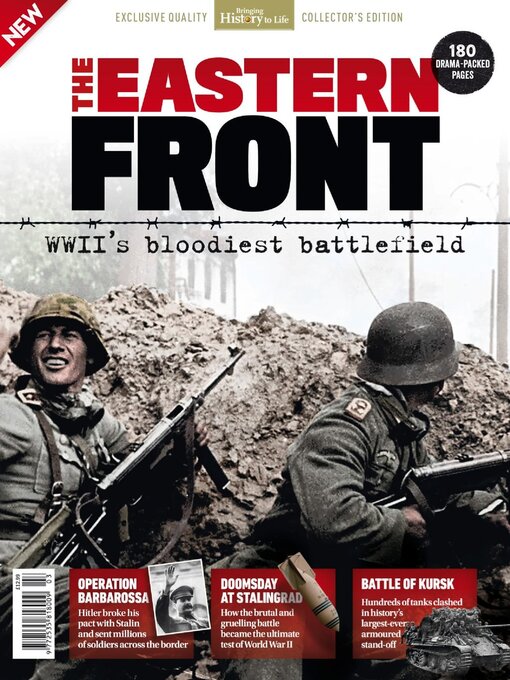
 Eastern Front 2
 Thanks! Battlefield Monsters of World War II
 Road to Victory
 Greatest battles WW2
 Slaughter at the Eastern front
 WW2 1939 - 1945
 WW2 Mysteries
 Hitler Life and Death
 Waffens SS
 The Rise & Fall of the Third Reich
Bringing History to Life Collector’s Edition’ is a 180 page must read special issue packed with in depth WW2 historical information narrated as a story and illustrated with informative graphs and timelines. Readers interested in WW2 will not be disappointed.
WELCOME
ALL HELL BROKE LOOSE AT DAWN • In the summer of 1941, the Soviet Union and Nazi Germany were, on paper, allies. But Germany was determined to crush the Soviet Bear and had secretly sent millions of troops to the Soviet border. Now, with another blitzkrieg, it planned to ensure Germany’s total domination of the European continent.
THE SOVIET LINE COLLAPSED • German tanks stormed through the Soviet Union, leaving the Red Army in total disarray. Desperate Soviet generals tried to slow the German advance with hopeless counter-attacks, resulting in casualties in the hundreds of thousands. By July 1941, Hitler was alarmingly close to securing Nazi dominance in Europe.
How German logistics worked
“At Leningrad there were only 437 of us left” • Aged just 17, Semen Chtipelman enlisted in the Red Army in 1940. The following year he stood at Leningrad and endured hunger, frost and death to help stop the German onslaught on the city. He was one of only a few from his unit to survive the fighting and see the war through to its bitter end.
LENINGRAD REFUSED TO SURRENDER • As the Germans stormed Leningrad, General Georgy Zhukov ordered everything to be put into defending the city. Thousands of civilians were sent to dig defences, citizen militias exercised in the city squares and soldiers formed a ring around the city. The Germans had to be stopped here.
BATTLE OF MOSCOW • German generals believed that Operation Barbarossa had delivered a series of crushing victories, and that the Soviet Union was on the verge of collapse. They were so sure that the capture of Moscow would send the enemy into the abyss that they drove their exhausted troops forward in one final push to crush the Red Army.
Germans exuded optimism in their letters • The soldiers of the German army were full of confidence as they marched towards Stalingrad. In a letter to his parents, Theodor Körner from Hamburg didn’t doubt for a second that the battle had already been won.
DEATH LURKED IN THE CLOUDS • On 23rd August 1942, bombs fell continuously as the war reached Stalingrad, and on this ‘Black Sunday’ the Luftwaffe massacred soldiers and civilians alike. As the Red Army took to the skies, its pilots’ lack of skill was plain to see. But in the clouds over the city, day by day, the Soviets slowly turned the tide of war.
RAT WAR IN THE RUINS • As German troops stormed Stalingrad on 13th September, it soon became clear that the operation would be more difficult than expected. Among the city’s fortifications of rubble and twisted steel, the Soviets fiercely defended every metre of ground. The soldiers called the bitter hand-to-hand fighting rat warfare.
DOOMSDAY AWAITED IN STALINGRAD • In early 1943, a brutal nightmare awaited the German soldiers fighting a lost battle against hunger, cold and empty cartridge boxes. Their commander was left helpless when, on 10th January, the Soviets launched a final major attack to liberate Stalingrad and crush the remnants of the German 6th Army.
ARMS RACE TO DECIDE THE WAR • In 1943 Hitler was nervous. The Blitzkrieg against the Soviet Union had become stuck, and he decided that only new wonder weapons could save Germany. Only two things counted to the Führer: size and thick armour. In Moscow, Stalin also dreamed of new weapons to secure victory against German planes and tanks.
THE NOT-SO-SECRET ATTACK • In the summer of 1943, almost 800,000 German soldiers, supported by 3,000 tanks, were ready to attack the Soviet positions at Kursk. The assault was prepared in secrecy – or so the Germans believed. But...